Lloyd Le Page is Chairman of Sarnian Group, Inc., which founds, owns and scales businesses that support food security, climate resilience and sustainable growth, combining entrepreneurial ownership with institutional investment discipline. Lloyd brings more than 35 years of experience in farming, agribusiness, agricultural policy and investment, spanning smallholder to large-scale operations. His career began as an agroforestry intern, and then as a farm manager on large-scale commercial farms. He previously served as CEO of the CGIAR Consortium, and as a Senior Adviser to the Tony Blair Institute, the World Bank and IFC on agriculture and food investment. He also spent more than 15 years with DuPont Pioneer, later part of Corteva. He serves on the Advisory Board of the Global Farmer Network and is co-founder of Regenera Natural Capital.
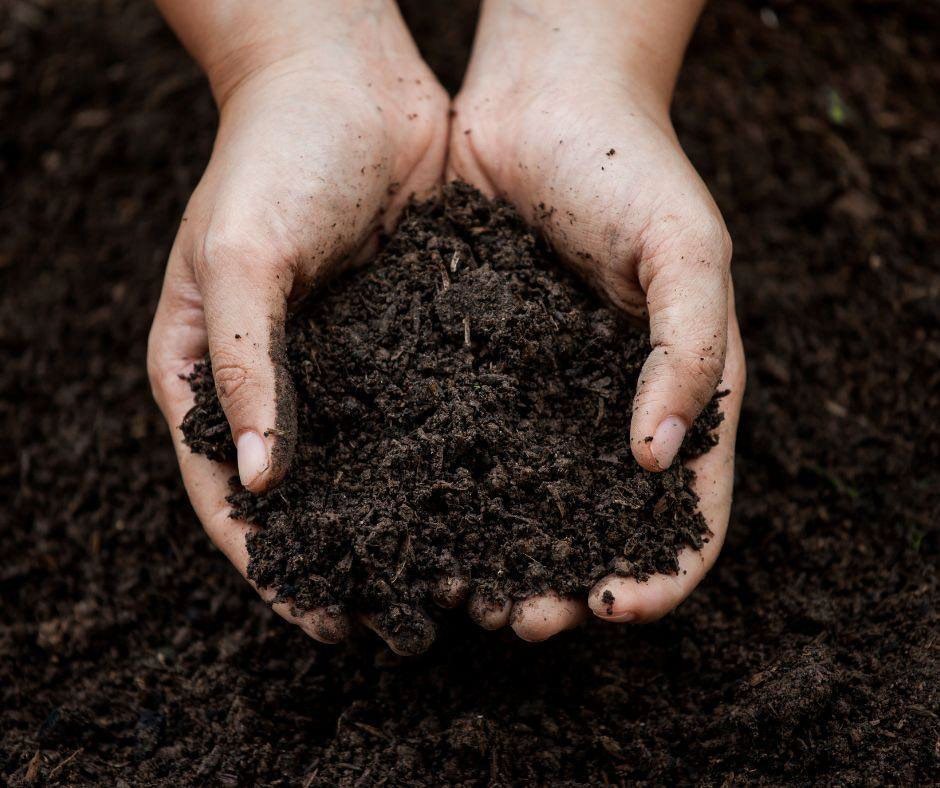
I have spent the last thirty-five years in global agriculture, and yet I still judge a farm the way I learned as a young farm manager, soil between my toes on fields I managed, and the way my first farm mentor Graham Stewart taught me: by kneeling down and putting my hand in the soil, whether in Zimbabwe, Chile, or Polk County, Iowa. If it is crumbly, soft and full of life, you are in good shape. If it is tired, compacted, hard to walk on barefoot, and washing away in the first heavy rain, no spreadsheet in a distant office will save you. Everything else (yield, margin, the bank's view of your land) flows from that handful.
That is why I want my fellow farmers to pay close attention to something that is starting to sound, from a distance, like just another piece of city vocabulary: Nature Capital.
I understand the eye-roll. We have lived through enough fashionable phrases, each announced as the future, each arriving with consultants, acronyms and a new form to fill in. Carbon finance came with that baggage, and for many farmers it never quite landed. The price moved, the rules changed, the buyer was invisible, and the farmer carried the risk. I have sat in enough farm kitchens and policy rooms, with growers of two hectares and operators of twenty thousand, to know that skepticism is earned.
But Nature Capital is not the same conversation. Properly designed with farmers in the room, Nature Capital approaches offer an opportunity to build on decades of conservation payments, make the full value of farm stewardship more visible, and invest in the natural assets on which productive agriculture depends. That is a conversation farmers cannot afford to leave to others.
Properly designed with farmers, Nature Capital can make the full value of farm stewardship visible, and pay for it.
This is not just carbon with a new label.
Let me be clear about the distinction because it matters.
Carbon finance, at its narrowest, asks one question: how many tons of carbon did you store or avoid? It is an important question, but it is a single metric, traded in a market most farmers cannot see, at a price most farmers cannot influence. It can reward a plantation and ignore a mixed farm. It can value a ton the same whether it was created with healthy soil and clean water, or at their expense.
Nature Capital starts with a wider and, frankly, more agricultural ledger. It asks: what is this land doing for soil health, for water (holding it, filtering it, releasing it slowly), for pollinators and natural pest control, for flood resilience downstream, for the hedgerows, wetlands and field margins that hold a landscape together? And what is that worth, not as charity, but as economic value?
It helps to be precise because these terms get used loosely. Natural capital is the stock: the soil, water, habitats and living organisms on and around a farm. Ecosystem services are the benefits that flow from that stock, such as clean water, pollination, flood protection and climate regulation. Conservation payments, payments for ecosystem services and investment arrangements are the mechanisms that finance the stewardship of the stock. Nature Capital, in other words, is a broader way of reading the farm ledger, not a single new payment scheme.
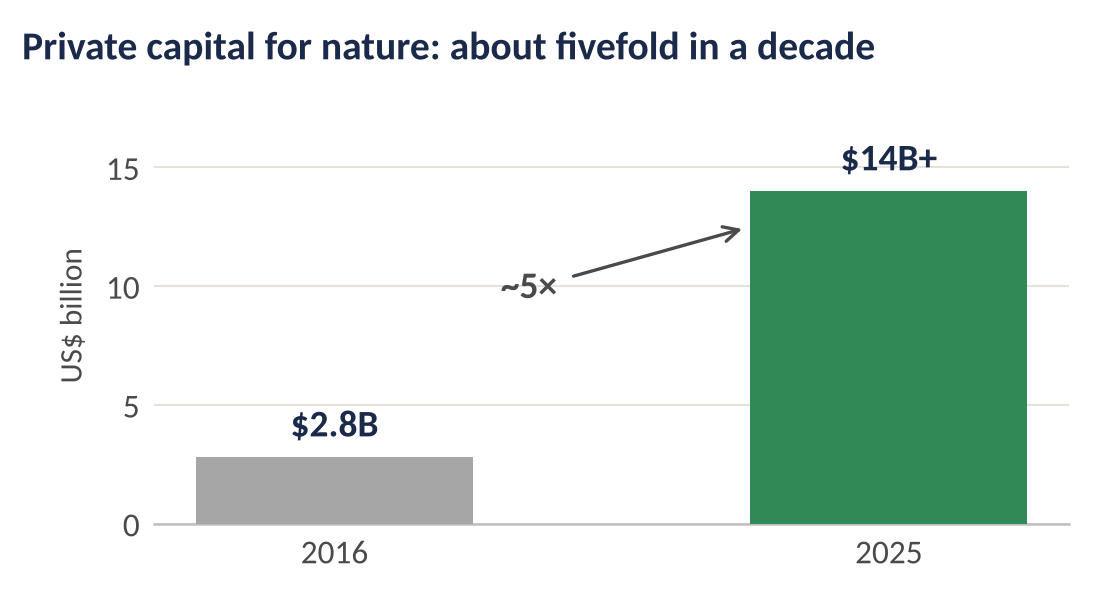
That is not a departure from farming. That is farming, described in the language that banks, insurance companies, food companies and governments are finally learning to use. When the OECD estimates global biodiversity finance at roughly $75–92 billion a year in 2023–25, and when analysts tracking private capital find allocations to nature-based projects rising from about $2.8 billion in 2016 to more than $14 billion in 2025, they are not describing a fringe. They are describing a re-pricing of risk and resilience that will reach the farm gate whether we shape it or not. I would rather farmers shape it.
A narrow carbon-only approach vs. what a well-designed Nature Capital approach should deliver
| Narrow carbon-only approach | Well-designed Nature Capital approach | |
|---|---|---|
| What is valued | Tons of CO₂ stored or avoided | Soil health, water, biodiversity, pollination, flood resilience, and carbon |
| Who pays | Credit buyers in a distant market | Governments, water utilities, food buyers, insurers and investors |
| Who benefits | The credit buyer, through its climate claim | The farm household, neighboring farms and downstream communities, and wider society |
| Farmer's risk | Price swings; farmer carries delivery risk | Shared transition risk; payment for agreed management, with outcome bonuses where measurement is credible |
| Farm benefit | Not necessarily | Should cut input costs and protect yield in a bad year, by design, not by label |
Soil is the first balance sheet.
Every farmer knows that soil is not dirt. It is a living account into which you deposit (cover crops, rotations, manure, rest) and from which you withdraw every single season. For decades, our formal balance sheet recognized the tractor, the shed and the tons in the store, but not the soil or organic matter, quietly disappearing under our boots.
That is changing, and not for sentimental reasons. Food companies that once bought on price alone now ask suppliers about soil because their own resilience depends on it. Nestlé, for example, has committed to sourcing 50% of its key ingredients from farmers using regenerative practices by 2030 and is working with partners such as Soil Capital to pay and support farmers through that transition. In their latest European program, they are working with around 230 farmers on 13,000 hectares, with monitoring that combines satellite imagery and field-level soil data. Danone reports 42% of its key ingredients now come from farms transitioning to regenerative agriculture, exceeding its earlier target. You may or may not sell to those companies. The signal is what matters: the buyer is starting to value the condition of the asset, not just the crop that comes off it.
For the farmer, the economics are refreshingly un-abstract. Healthier soil holds more water in a dry spell and drains better in a wet one. Depending on the soil, crop, climate and management, it can need less bought-in nitrogen for the same yield. It resists erosion, which is your capital literally leaving the farm. If an investor or a buyer wants to help pay for the cover crop, the reduced tillage or the soil testing that gets you there, not as a handout but because it de-risks their supply chain, that is not greenwashing. It is a business proposition worth hearing out.
Getting paid for what we already give away free.
Here is a frustration I have heard in every country I have worked with, from family farms in Europe to smallholders in Africa and megafarms in Latin America and ranchers in North America: the good farmer maintains the landscape that everyone else enjoys (the clean stream, the pollinated crop next door, the village that does not flood) and is thanked, if at all, with a regulation.
The value created by good stewardship does not stop at the farm gate. Soil kept on a hillside can mean less sediment in a village's drinking water; a restored wetland can reduce riverbank erosion and flood exposure downstream; connected habitat can support pollination across neighboring farms. Taken together, these changes contribute to climate stability, biodiversity and food-system resilience well beyond the local landscape, including for generations not yet born. Much of that value never shows up in the farmer's income. A credible Nature Capital approach should identify who benefits, measure those benefits, and make sure the farmers producing them receive a fair share of the value.
It helps to think of the benefits at three levels, each with its own yardsticks.
Who benefits from farm stewardship, and how to measure it
| Level | What good stewardship can deliver | How to measure it |
|---|---|---|
| The farm household | Better profitability, lower input costs, greater resilience | Net farm income, input spending, yield variability over several seasons |
| Neighboring farms and local communities | Cleaner water, less flood damage, pollination, local jobs and livelihoods | Water quality, sediment and nutrient loads, households benefiting, damage avoided, neighboring crop performance |
| Wider society, including future generations | Climate regulation, biodiversity, more resilient food systems | Verified emissions reductions, habitat condition and connectivity, how long the improvements last |
The important point is to demonstrate these benefits, not assume them. That means a baseline before the work starts, an honest view of what would have happened without it, and a clear line between results that were measured and estimates that were modeled. Farmers have been burned before by schemes that promised much on paper and paid little in the field. Evidence protects them as much as it protects the buyer.
Communities downstream are often the biggest beneficiaries and the least able to pay. A village cannot write the farmer upstream a check for cleaner water. That is where governments, water utilities and businesses come in, financing the benefit on the community's behalf and recovering the cost through rates, taxes or a more secure supply chain.
Payments for ecosystem services try to correct that, plainly and commercially: if society, a water company, a food business or a government wants a measurable service from the land, it pays the land manager who provides it.
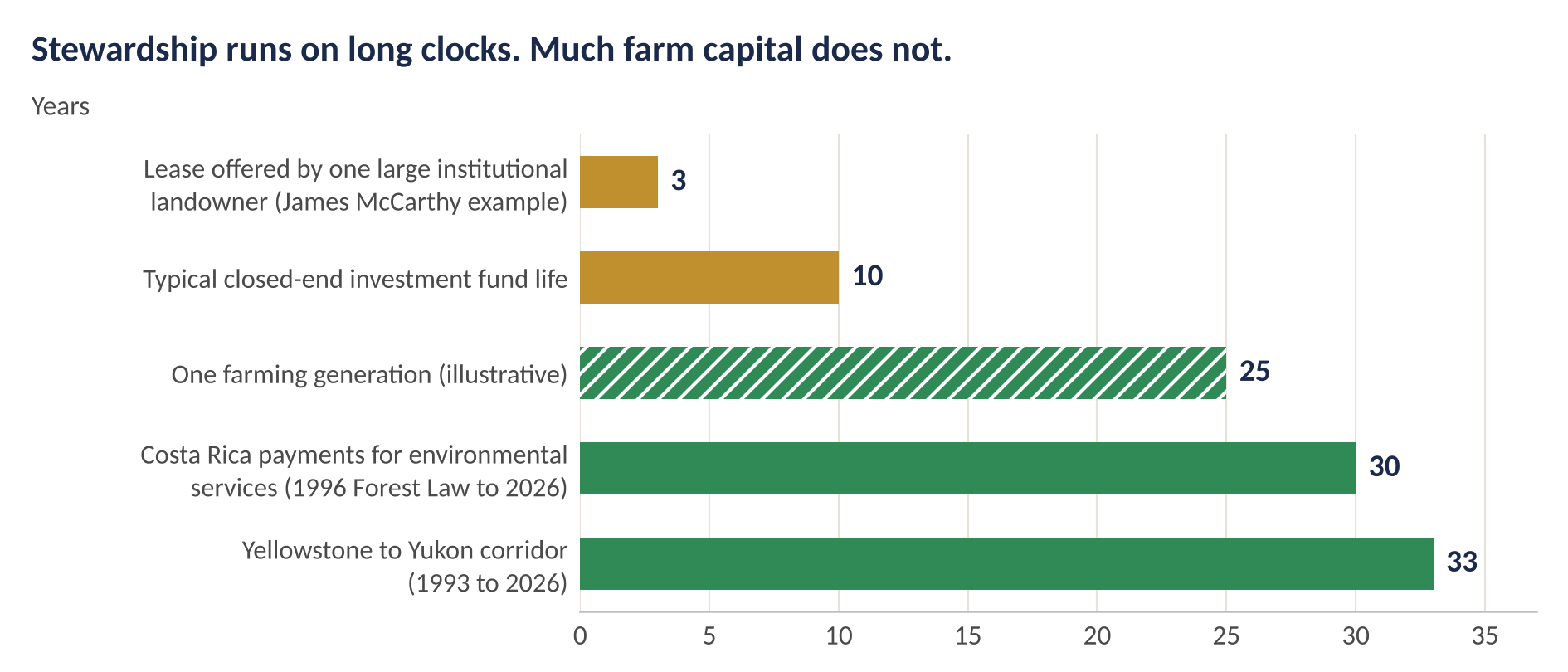
This is not theory. Costa Rica's national Payments for Environmental Services program, created under its 1996 Forest Law and run through FONAFIFO, has paid landowners more than $565 million to conserve over 1.15 million hectares for carbon, water, biodiversity and scenic value, funded in part by a fuel tax. Whatever you think of any single scheme, Costa Rica demonstrated something farmers should note: a country decided that stewardship was a service worth contracting for, at national scale, for decades.
The United States has its own long-running example. USDA's Conservation Stewardship Program pays producers on working farms, ranches and forests under five-year contracts, with one part of the payment for maintaining the conservation they already practice and another for taking on additional activities. Nature Capital does not replace that heritage. The opportunity is to build on it, connecting several ecological benefits at once with farm economics, longer-term investment and a wider range of funders.
It pays to keep three things apart. Rewarding the maintenance of good stewardship already in place is one. Financing additional ecological improvements is another. Selling credits that carry a specific environmental claim is a third. All are legitimate, but the reason for paying and the evidence required differ: the first needs proof the practice is being kept up, the second a baseline and a measured change, the third the full discipline of additionality, permanence and independent verification. Keeping them separate also resolves an old tension, between paying good farmers for what they already do and demonstrating something new. Where one hectare produces several benefits, several funders can share the cost, provided the arrangements are transparent and the same environmental claim is never sold twice.
In England, the shift is happening through the Environmental Land Management schemes. Spending on the Sustainable Farming Incentive more than doubled to £738 million in 2025–26, with some 44,500 live agreements covering 35,600 farm businesses as of November 2025, as old area-based payments are phased down. Farmers there will argue, sometimes fiercely, about rates, complexity and timing, and they are right to. The direction of travel is unmistakable: public money is moving from paying for hectares owned to paying for outcomes delivered. But the public purse is tightening. When the latest SFI application window opened in late September 2026, its £253 million budget was fully allocated in under six hours, and some 12,500 farmers with existing agreements missed out on a new one. As Paul Temple, who farms on the Yorkshire Wolds (UK) and is a fellow Global Farmer Network member, pointed out to me, government schemes are being wound back under budget pressure and their own complexity. Stewardship will need paying for over decades, and public money alone will not carry it.
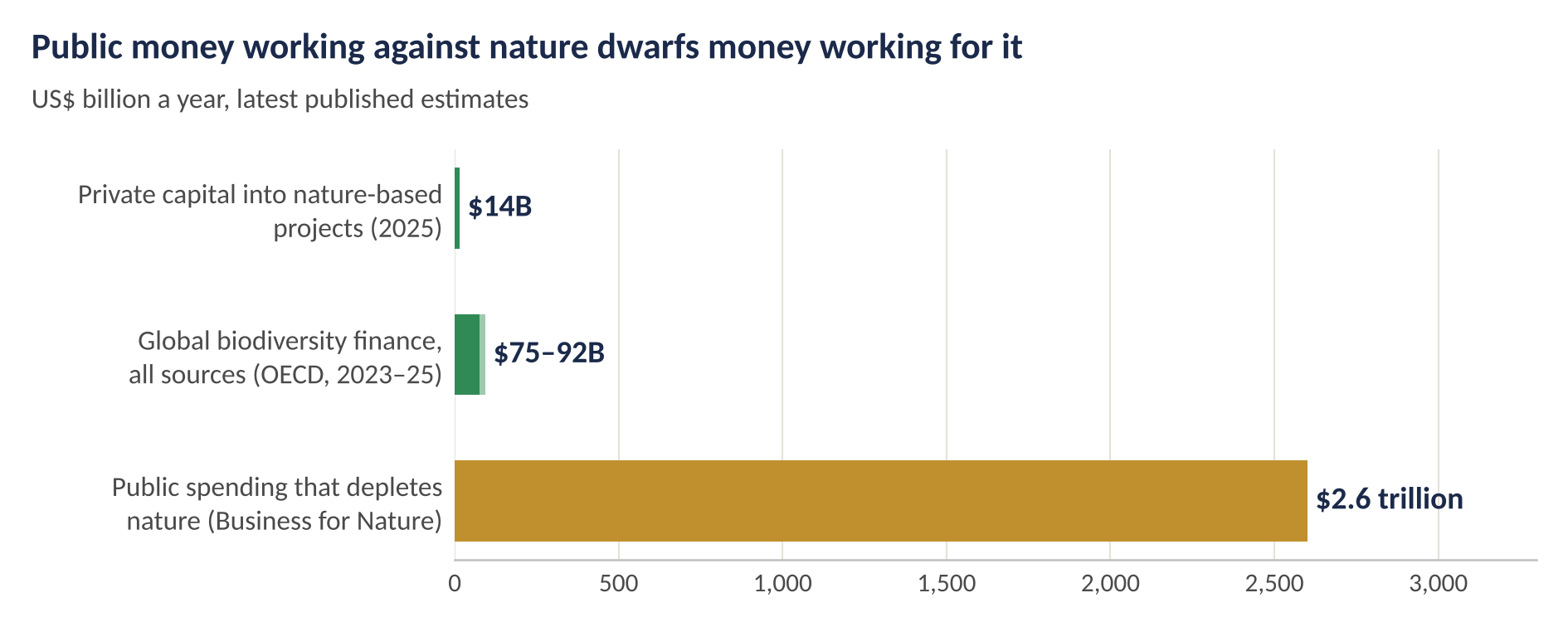
Business is now pressing governments in the same direction. Ahead of the COP17 Biodiversity Summit, more than 130 businesses and financial institutions, among them Nestlé, Danone, Unilever and Rabobank, signed an open letter convened by Business for Nature and the Finance for Biodiversity Foundation calling for reform of the incentives governments already fund. The signatories represent more than US$600 billion in revenue and US$4.7 trillion in assets under management. Their central figure should give every farm minister pause: at least US$2.6 trillion a year of public spending, close to 2.5% of global GDP, still contributes to depleting the natural resources that farming and food supply chains depend on. The letter is not asking for new money. It is asking that existing public money reward the right things. Farmers should back that, provided reform means paying for stewardship rather than quietly withdrawing support.
For a farmer reading this, the practical question is not whether you love the acronym. It is whether, in your country, a payment exists, or is being designed, for the hedgerow you maintain, the wetland you protect, the soil carbon you build or the water you slow down. If it is being designed and farmers are not at the table, the rates will be wrong, the paperwork will be unbearable, and the small farmer especially will be designed out. That is a policy failure we have seen before, and it is avoidable if we engage early.
If a Nature Capital scheme is being designed and farmers are not at the table, the rates will be wrong, and the small farmer especially will be designed out.
Farmers think in generations. Investors should too.
There is one thing that sets farming apart from almost every other asset class, and investors would do well to understand it early. Most farmers do not farm for this year's return on land capital. They farm to hand the land on in better heart than they received it, to a son or daughter, a niece or nephew, or a neighbor's youngster who has shown the knack. Paul made this point to me when he read an early draft of this piece: "Whatever their suspicion of the terminology, farmers will embrace a scheme that genuinely rewards good practice, and they will want it to work, because the land they are improving is the land their grandchildren will farm."
That long view changes the job itself. Merle Massie, who farms in Saskatchewan, Canada and is another Global Farmer Network member, argues that this kind of focus moves the framework from producer to steward, and that it is a far better reflection of what happens on the ground. On her family's farm, stewardship means regrassing or rewilding marginal acres, valuing the sloughs, dams, shelter belts and native prairie, and cleaning up old yard sites for new purposes. That is land management at scale and over time, and almost none of it shows up on a yield map. Each year the Canadian agricultural survey becomes a small lesson in explaining to someone who has never farmed that a family can own six quarter sections, 960 acres, and still not have every acre in crop. Those acres are not idle. They are working capital of a different kind, and a well-designed Nature Capital approach is built to recognize them.
Merle's father, Sargent McGowan, wrote about a lonely, driven farmer who had chased money with single-minded determination, only to find a hollow victory of land and possessions as the end of his working life approached. His conclusion is the best summary of the intergenerational case I know: "I know this much: a man can't farm just for the money … you have to know why, how, and for whom. If any of these are missing, there is problems." Investors should carry those three questions into every Nature Capital deal. A scheme that cannot answer all three for the farmer will struggle, however good the spreadsheet looks.
Regenerative and circular: farming that pays back on the farm first.
I am wary of labels, and "regenerative" is in danger of becoming one of those words that means everything and therefore nothing. On a real farm, though, the underlying practices are neither new nor mysterious. Rotations that rest the land. Livestock integrated thoughtfully rather than banished or concentrated without thought. Cover kept on the soil. Inputs used precisely, not prophylactically. Many of our grandparents would recognize it; they would just wonder why we needed a conference to rediscover it.
What is new is that the economics are being underwritten. When a company like McCain talks about regenerative potatoes, or when Nestlé and Danone put multi-year money behind farmer transition rather than simply setting a deadline and walking away, they are acknowledging a truth farmers have always known: the transition costs money up front (in learning, in equipment, in a year or two of uncertain yield) while the benefits compound slowly. Sharing that risk is the difference between a slogan and a program.
Circular agriculture makes the same point from another angle. The Netherlands, hardly a country that can afford waste, built a national vision around closing nutrient loops: using crop residues, food-industry by-products and processed manure as resources rather than disposal problems, and measuring nutrient flows farm by farm. Dutch researchers and farmers are now "unraveling" manure into biogas, recovered nitrogen, phosphate and soil improvers, and even revisiting how nutrients from wastewater can safely return to land. Strip away the policy language and this is what every thrifty farmer has always preached: do not buy what you can reuse, and do not throw away what still has value. When fertilizer prices spike, as every farmer reading this has lived through, the circular farm is not just virtuous. It is cheaper to run.
The farmer's test for either label should be brutally simple. Does it lower my bought-in costs, protect my yield in a bad year, or open a market I could not reach before? If a regenerative or circular proposition cannot answer yes to at least one of those, it is a hobby. If it can, it deserves a hearing regardless of what it is called.
Biologicals and new technology: tools, not silver bullets.
If there is one area where I would urge both enthusiasm and discipline, it is biologicals and the new generation of agricultural technology.
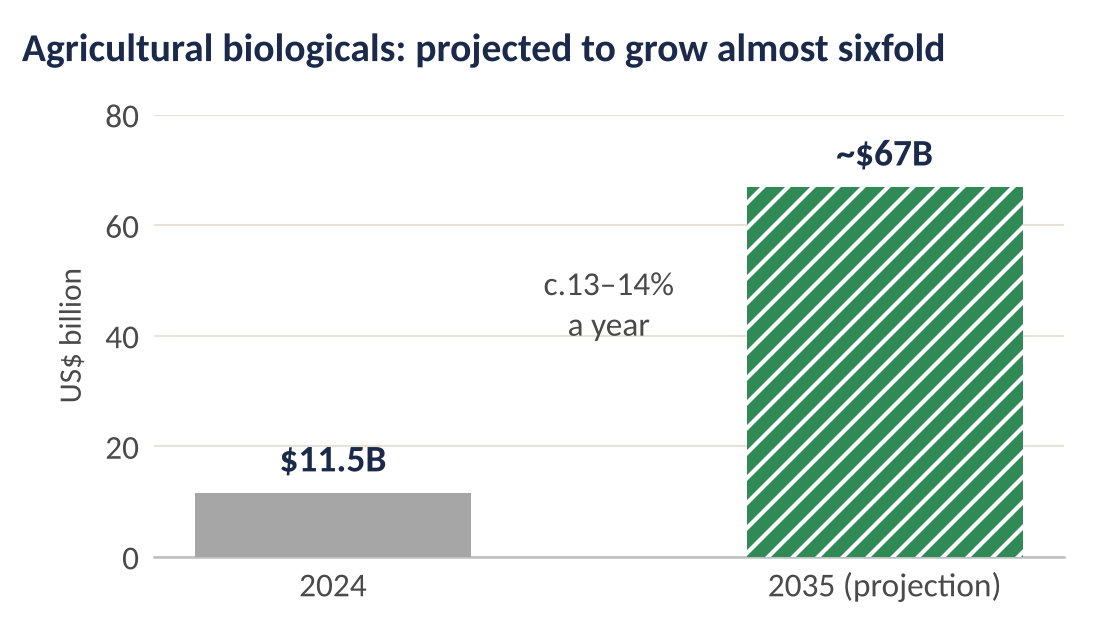
Biologicals (biopesticides, biofertilizers and bio-stimulants built from microbes, fungi and natural compounds) are moving from the edge of the merchant's catalog to its center. Industry estimates put the agricultural biologicals market at about $11.5 billion in 2024, growing at roughly 13–14% a year toward just short of $67 billion or more by the mid-2030s. The major crop-science houses, Bayer, Syngenta, Corteva and BASF, now compete in biologicals alongside specialists like Koppert and Lallemand, and the latest retailer surveys in the United States show Corteva and BASF as the most common biologicals suppliers to farm retailers. That shift of serious capital and distribution tells you this is no longer a niche for the converted.
On my own assessment, biologicals earn their place when they do a specific job well, such as fixing nitrogen more reliably, protecting a crop with fewer residues for a demanding buyer, helping a plant through heat or drought stress, and when they are integrated with good agronomy rather than sold as a replacement for it. The same is true of the wider technology wave: soil-moisture sensors that tell you not to irrigate today, satellite and drone imagery that finds stress before the eye can, AI-assisted scouting, and precision application that puts the right dose in the right place. Many of these are contained in Sarnian's "Sentinel Nature". None of these will farm for you. All of them, used well, help a good farmer waste less of three expensive things: water, fertilizer and time.
My caution, offered as someone who has watched technology cycles come and go, is to insist that these tools prove themselves in your soil, in your climate, at your scale. A product proven on a research station in another hemisphere is a hypothesis, not a promise. Good companies know this and will trial with you. Those who will not should not be surprised when farmers decline to be their unpaid research department.
Water will be the sharpest price signal.
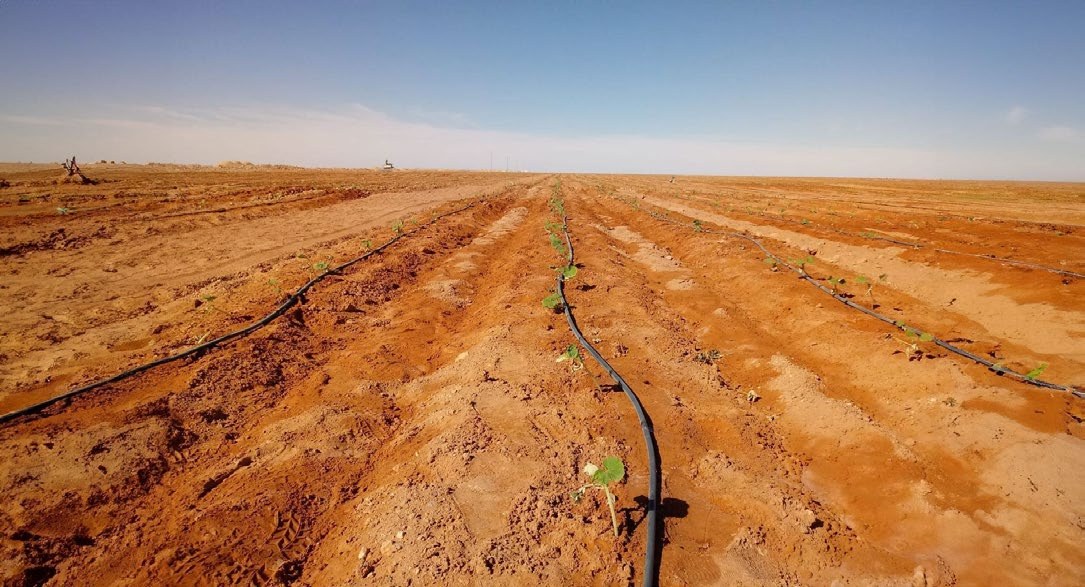
If soil is the first balance sheet, water is the first argument. Almost every serious farm dispute I have ever been near, whether between neighbors, between farms and cities, or between agriculture and the environment, is, underneath, an argument about water: who gets it, when, and in what condition it leaves.
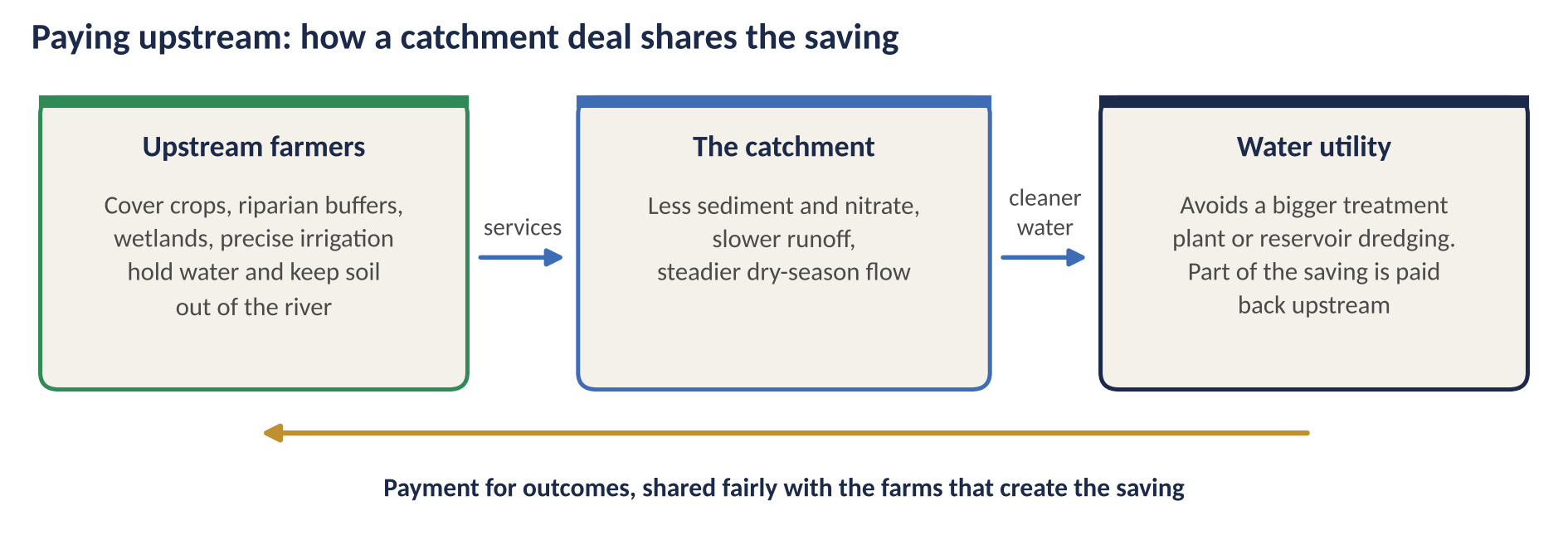
Nature Capital puts a value on the farmer's role in that cycle, and I believe water stewardship will become the most concrete of all the payments and investments now emerging. The farmer who slows runoff, restores a riparian buffer, recharges an aquifer or irrigates precisely is not just being neighborly. That farmer is providing flood protection, water quality and dry-season flow to people far beyond the boundary fence.
We know efficient water management pays on the farm itself. Israel's farmers made drip irrigation, delivering water to the root rather than the sky, the foundation of a productive agriculture in an arid land, a technology developed by companies like Netafim and now used from Californian vineyards to smallholder plots in India. In Niger, a program supported by IFC and Netafim took a different lesson to heart: earlier drip schemes had failed not because the technology was wrong but because farmers lacked training and spare parts. With community field assistants, soil analysis and crop calendars, women's groups in places like Garou, in the Dosso region, moved from carrying water in buckets to harvesting okra and watermelon at the moment local prices were highest. That is water management as income, not as compliance.
Investors and water utilities are beginning to pay attention to the upstream farmer for the same reason. Depending on the catchment and the intervention, it can be cheaper to help a catchment of farmers hold water and keep soil out of the river than to build a bigger treatment plant or dredge a reservoir downstream. New York City is the best-known case: since 1997 it has spent some $2.5 billion protecting its Catskill and Delaware watersheds, including work with upstream dairy farmers on manure and nutrients, and in doing so has put off a filtration plant estimated at up to $10 billion. When that saving is shared fairly with the farms that create it, everybody wins. When it is not, farmers are entitled to ask why they should carry the cost.
From ecological value to a farmer's bank account.
It is one thing to say clean water has economic value and another to say who will pay the farmer for it. Farmers will want to see the mechanics. Take an illustrative case: a water utility paying farmers along a river to establish and maintain riparian buffers. A fair deal should answer six questions plainly.
Anatomy of a fair catchment deal (illustrative, not a specific scheme)
| Question | In this example | What to look for |
|---|---|---|
| Who pays, and why? | The water utility, to cut treatment costs and protect supply | A payer with a real, recurring benefit, not a one-off grant looking for a home |
| What does the farmer agree to do? | Fence and plant a buffer strip, manage livestock access, maintain it | Practices written in plain language, with independent advice available before signing |
| What does the payment cover? | Establishment costs up front, an annual maintenance payment, a bonus if water quality improves | Clarity on transition, ongoing and outcome payments, and how each is calculated |
| Who pays for monitoring and verification? | The utility, as part of its own water-quality monitoring | Verification costs not quietly netted off the farmer's payment |
| Who carries weather and delivery risk? | Management payments made regardless of rainfall; drought and flood handled by named clauses | Shocks the farmer cannot control spelled out at the start |
| What does the farmer keep? | The payments, less any agreed fees, plus less erosion on the land | Net payment after implementation costs and intermediary fees, stated in the contract |
It also matters what kind of money it is. A grant carries no repayment but usually comes with conditions. A payment for services is earned by doing the work or delivering the result. A loan has to be repaid from farm cash flow, however good the cause. Equity takes a share of the upside and often a say in the business. All four can support stewardship, but they leave the farmer with quite different obligations. And a higher valuation of a farm's natural assets does not, by itself, put a dollar in the bank to pay for improving them.
Nature corridors need farmers, not fences.
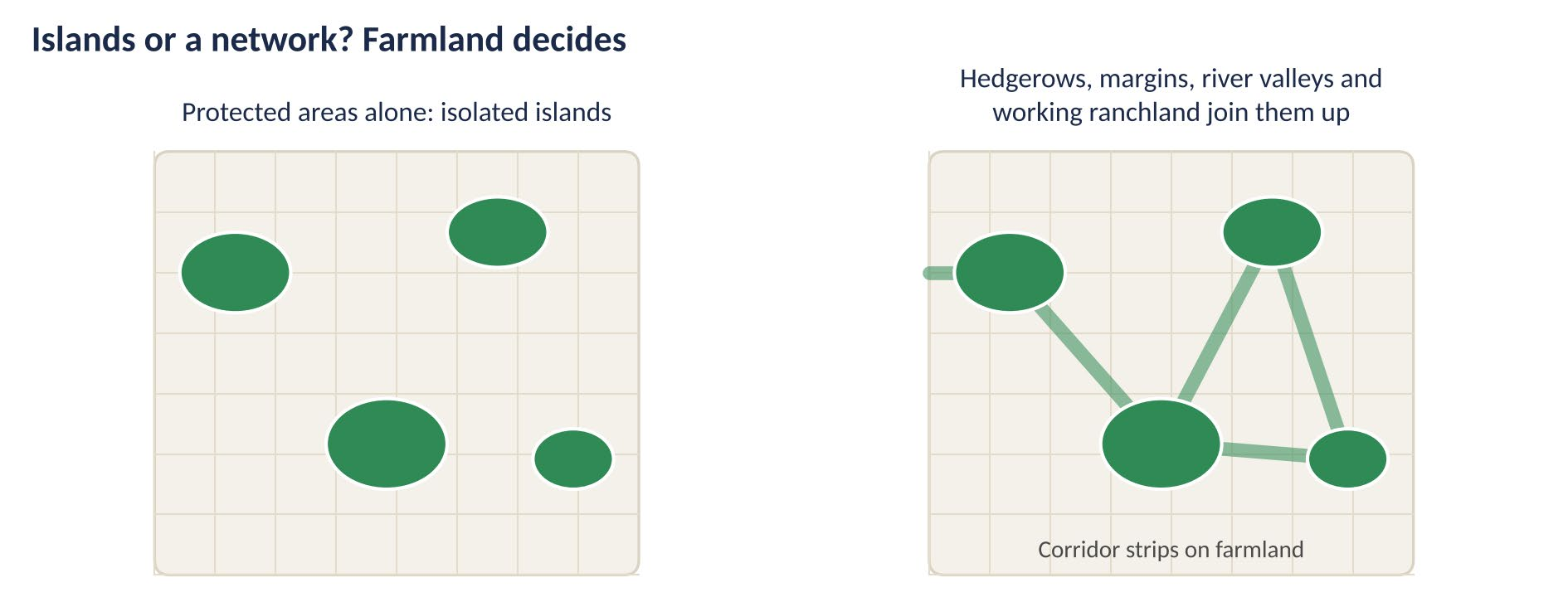
There is a picture of conservation that I want to retire: a map with green blobs for protected areas and blank space in between, as if the land between parks were empty. It is not empty. It is farmed, ranched, lived in and owned, often by the very people whose knowledge of that land goes back generations.
Nature corridors, the hedgerow networks, river valleys, field margins and working ranchlands that let pollinators, birds and mammals move across a landscape, will succeed or fail on farmland. The science is now unarguable that isolated reserves, however well protected, are not enough for wide-ranging species. The Yellowstone to Yukon Conservation Initiative, launched in 1993 after a collared wolf named Pluie wandered across 100,000 square kilometers and every jurisdiction imaginable, has spent three decades proving the alternative: a 3,400-kilometer corridor through the Rockies, built not by expropriation but through partnerships with private landowners, Indigenous Nations, governments and scientists, helping to create 204 wildlife crossings and protect some 24 million hectares. It was named a 2026 finalist for the Earthshot Prize. I am less interested in the prize than in the method: crossings, easements and coexistence measures negotiated with the people who live there.
At the scale of a single farm, a corridor can be as modest as a flower-rich margin that feeds the pollinators your own crop depends on, a restored hedge that shelters livestock and holds the bank of a stream, or a gateway left open rather than fenced across a known wildlife route. The point for farmers is not to turn productive land into a museum. It is that connectivity, like soil and water, is becoming something buyers, governments and conservation investors will pay to maintain, and the farmer who provides it should be a paid partner, not a regulated bystander.
I have seen corridor projects fail when they were drawn on a map in a capital city and announced to the community as a fait accompli. I have seen them succeed when a rancher was asked, early and respectfully, where the elk actually cross. Investors take note: local ecological knowledge is not a courtesy. It is due diligence.
The same goes for everyone with a stake in the land, not only the person on the title. Tenants, women farmers, customary land users and households that depend on shared water, grazing or forest all belong at the table. The questions are plain: who controls the land, who does the work, who gets paid, and who might bear new costs? A corridor can deliver real biodiversity gains while increasing crop damage from wildlife or closing off grazing a neighbor relied on. Benefits beyond the farm only add up if the costs beyond the farm are counted too.
A challenge to investors: come to the farm gate.
So let me speak directly to the investors reading this, because farmers are often talked about in rooms they are not invited into.
The money is real, and it is growing. Banks are creating dedicated natural-capital divisions. Crédit Agricole, for instance, has launched one with an Amundi fund targeting some $227 million for forest restoration in France and Europe. Pension capital that once saw ecological restoration as too risky now backs wetland and stream mitigation in the United States through managers like Ecosystem Investment Partners, because clear regulation made the revenue predictable. Private capital for nature has grown roughly fivefold in a decade. This is welcome. Farmers have complained for years, rightly, that agriculture is expected to deliver public goods on private margins. New capital that shares the cost is overdue. It is also why, at the Nordic Climate Finance Summit in Oslo in September, we launched Regenera Natural Capital as a 50-50 joint venture between Sarnian Group and Fellow Future, to develop restoration, forestry, mangrove and conservation assets in Latin America and Africa as operating businesses first, with carbon and biodiversity revenue as upside rather than the thesis. Operating first, carbon second.
But hear this, plainly, from someone who has spent a career translating between farm and finance: capital that arrives with a lecture will fail, and capital that arrives with ears will succeed.
Farmers are not short of people telling them what the world needs from their land. We are short of partners who begin by asking what a change will do to a family's cash flow in year one, who understand that a smallholder in Kenya, a family farm in Iowa and a station in Australia face utterly different risks, and who are willing to be told that a beautifully modeled intervention does not survive contact with a wet harvest. The World Economic Forum's recent work on financing nature makes a point I wish every investor would tape to the wall: the biggest barrier is not a shortage of worthy ideals but a weak pipeline of genuinely investable, well-designed projects. Pipelines are not built in boardrooms. They are built farm by farm, with agronomists, cooperatives and farmer organizations who can aggregate small farms into something investable without crushing them with paperwork.
James McCarthy, an Irishman who farms in Romania and has spent some thirty years raising money for and putting together large farm investments, read an early draft and put it more bluntly than I have. He has watched outside capital arrive with a handsome spreadsheet and a snippet of new technology, convinced that the two together will multiply farm profits. In his experience that is the shortcut to bankruptcy. He tells of the chairman of a hedge fund, newly into agriculture and holding a doctorate in physics, who assured him that "with top-class management the yields would be the same every year, and that any variation came from poor management." Anyone who has farmed through a drought, a wet harvest or a late frost will know what to make of that.
The same investors are often the quickest to call generational farmers slow to change. I would turn that around. A farmer who has carried the full cost of a failed innovation on his own balance sheet learns to test before he adopts. That caution is risk management, not stubbornness. He is pricing the risk the spreadsheet left out.
James's sharper worry, and mine, is capital that wants to own farmland but not to farm it. Farming is seen as too risky; what the fund wants is a predictable rent and steady growth in land value, and he has seen 6% a year penciled in. He describes one of the world's largest institutional landowners refusing its farming tenants any lease longer than three years. For Nature Capital that is a serious problem. About 40% of farmland in the contiguous United States is rented, according to the USDA's Economic Research Service, and its 2024 study found that share-rented fields lagged owner-operated fields on cover crop adoption across all five crops it examined, though cash-rented fields largely kept pace. No farmer plants an orchard on a three-year lease, and soil organic matter, water tables and hedgerow habitat recover more slowly than any orchard grows. If an investor wants soil carbon and biodiversity on its land, the lease has to run long enough for the tenant to earn a return on putting them there.
James also gave me a line I intend to borrow: culture is what people think, not what they say. Too much outside money in agriculture produces the right sound bites and then behaves quite differently once the deal is signed. Farmers notice. They will judge a fund by its lease terms and its payment record, not by its sustainability report.
So here is my challenge, offered in good faith. Spend a day on a farm before you spend a dollar on one. Ask the farmer what keeps her awake. It will rarely be the metric at the top of your slide deck. Structure deals so the farmer is not the only one carrying transition risk. If you own the land, give the farmer a lease long enough for the soil and the habitat to respond. Pay on time, in full, for outcomes you have agreed how to measure. And when a farmer tells you a practice will not work on his land, believe him the first time. He is not resisting change. He is telling you where the change needs to be redesigned.
Capital that arrives with a lecture will fail. Capital that arrives with ears will succeed.
What good looks like: a farmer's five tests.
Over the years I have developed a habit, in policy discussions, of reducing any grand scheme to the questions a farmer would ask at the kitchen table. If a Nature Capital proposition, whether a payment scheme, a supply-chain program or an investment fund, cannot pass these five tests, I advise caution, however impressive the brochure.
Five tests for a credible farmer-friendly Nature Capital proposition
| Farmer's test | What good looks like |
|---|---|
| It is intelligible. | I can explain it to my neighbor in two minutes. If the contract needs a lawyer to translate what you are being paid for, it is not ready for farms. And I can get independent advice before I sign. |
| It pays, properly and on time. | The payment covers the real cost, including my time, the learning curve and the risk of a bad year, with something left over for the family. Conservation that relies on farmer subsidy, paid in exposure and gratitude, does not scale. |
| It measures what I actually do. | I am paid for the management I agree to deliver (soil cover kept, buffers maintained, habitat looked after), with outcome bonuses where measurement is credible. The contract says up front how drought, fire and other shocks beyond my control are handled. Measurement is fair and, where possible, uses tools I can see and query, not a black box in another country. |
| It respects scale, all scales. | It works for a farm of my size, or it honestly says it does not and helps me aggregate with neighbors through a cooperative or producer group, rather than quietly designing me out. |
| It was designed with the people affected, and I can walk away. | I was in the room when it was designed, with the tenants and neighbors who share the water, grazing or forest it affects, and it explains how benefits are shared. I can leave without being punished if it stops working for my farm, and any repayment or restoration obligations are clear from day one. Partnership you cannot exit is not partnership. |
Farmers are ready to talk.
I joined the advisory board of the Global Farmer Network because I believe farmers learn fastest from each other, across borders and farm sizes, and because I have seen what happens when farmers speak with one informed voice in rooms where decisions are made. The Nature Capital conversation is exactly such a room, and it is currently short of farmers. Several Global Farmer Network members read this piece in draft, and their comments have made it better.
Let me end where I began, with my hand in the soil. That soil, and the water that moves through it, and the living things above and below it, are the oldest capital any of us will ever manage. For most of my thirty-five years in this business, we were paid only for what we could load onto a truck. We are entering a period (I do not know how long it will last, and I make no apology for urging farmers to test it rigorously) in which we may also be paid for what we keep: the soil that stays, the water that runs clear, the landscape that still works for the creatures we share it with.
That is not a threat to farming. Done well, with farmers as authors rather than extras, it is the most farmer-shaped opportunity I have seen in a generation: a chance to be recognized, and compensated, for the stewardship we have always provided, and to build farms that are more resilient and more profitable for the grandchildren who will kneel, as we did, and judge the land by the feel of it.
To my farmer friends: do not wait to be invited. Ask what is being designed in your region, join the discussion through your farmer organization, and bring your five tests with you, along with Sargent McGowan's three questions: why, how and for whom.
To investors: we are ready to talk. Come to the farm gate. We will show you the soil, and we will listen, if you will.
Disclosure and note on sources: This is an opinion editorial. The author is Chairman of Sarnian Group, Inc. and co-founder of Regenera Natural Capital, a joint venture of Sarnian Group and Fellow Future that develops restoration and conservation assets in Latin America and Africa. Figures are drawn from the published sources linked above as reported at the time of writing; readers and editors should verify the latest published figures before republication. No investment advice is offered or implied. Header photo: AgronX.
Further reading: AgFunder News on biological-control funding · Pioneer centenary and the Long Look (Greater Des Moines Partnership) · Sarnian Group
Discussion
Loading comments…
Leave a Comment